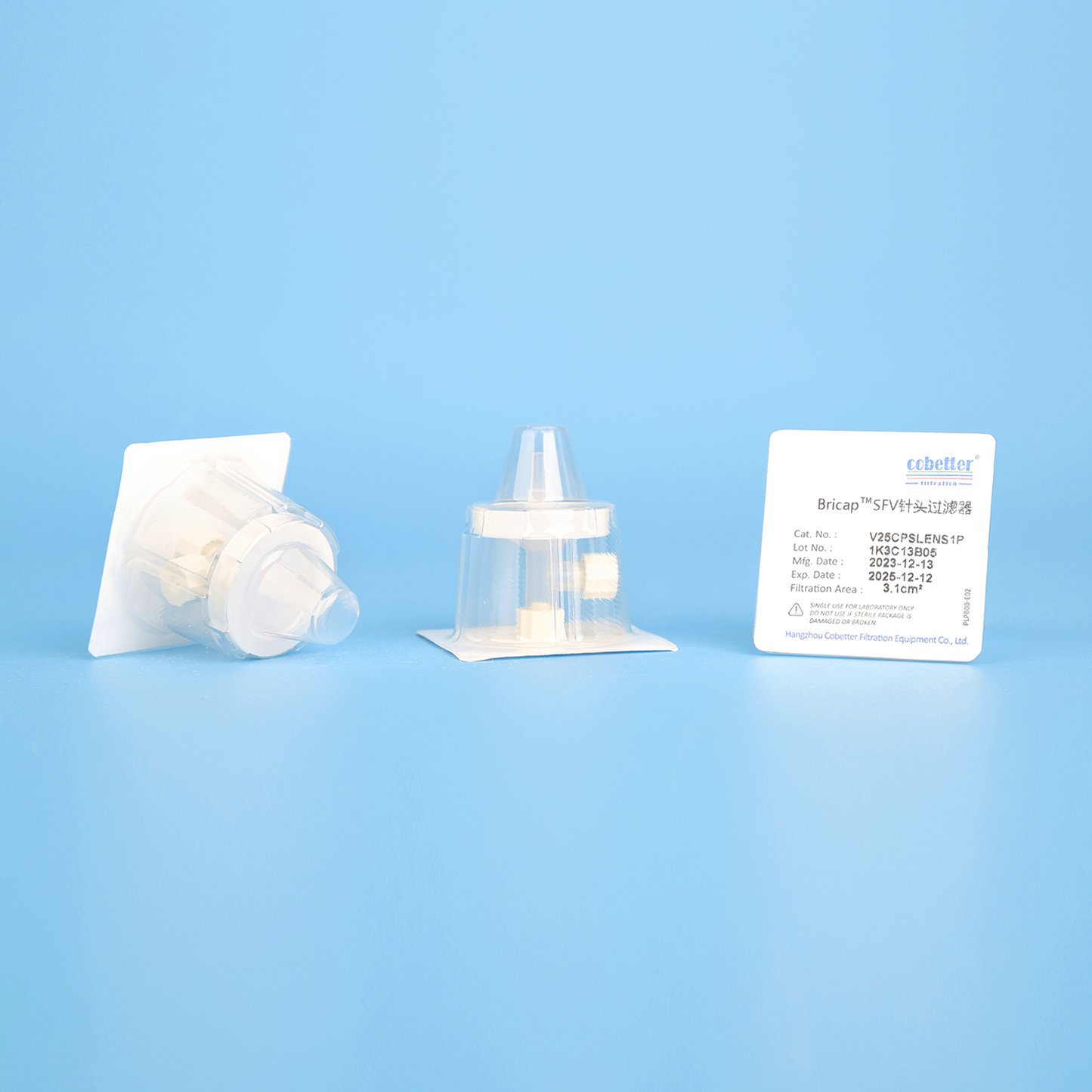
Purcise™ SLE 0.2 μm PES Sterilizing-Grade Syringe Filter for Filterability Study Pack of 100

In stock
Part No. U13CPSLESA1QP
Regular price $60.00 USD
Diameter
Connectors
Sterility
Loading locations...
*Ships within 5-12 Business Days
*Customers are responsible for any import duties or taxes
*Read our Shipping Policy and Refund Policy
*Not for medical use

Bricap™ Syringe Filters are designed for lab filterability studies. They are ideal for material testing and screening in the process development stage.

Purcise™ SLE features sterilizing-grade filters with double-layer hydrophilic Polyethersulfone (PES) membrane, offering low protein adsorption and excellent filtration efficiency, making them a preferred solution for final sterile filtration in biopharmaceutical manufacturing processes.

Features

  • Double Layer Hydrophilic Polyethersulfone (PES) Membrane: 0.45 μm pre-filter + 0.2 μm final filter membrane, ensuring high throughput and flow rate. Exceptional chemical compatibility. Low adsorption and low leachable.
  • Sterilizing -grade Filter: Bacterial Retention validated according to ASTM F838, each filter is integrity tested prior to release.
  • Linear Scale Up: Available in syringe filter for filterability study, small-scale capsule filter for process development, and large-scale capusle filter and filter cartridge for commercial GMP manufacturing.

Applications

  • Sterile filtration of terminal products
  • Sterile filtration of biological products
  • Blood and serum products
  • Sterile filtration of vaccine products
  • Pre-column/ultra-filtration protection
  • Filtration of intermediate products/stock solutions

Quality Standards

  • ISO 9001: 2015 Quality Management System
  • Manufactured for use in conformance with cGMP
  • COA/COQ provided with shipment
Physical Properties Filter Format Bricap™ Syringe Filter
Scale Process Development, for Filterability Test
Filtration Area φ13 mm (0.72 cm²)
φ25 mm (3.4 cm²)
φ33 mm (4.5 cm²)
V25 with Luer Vent (3.1 cm²)
Pore Size 0.2 μm (final-filter)
Pre-filter 0.45 μm
Bubble Point ≥0.39 MPa at 20 °C, water wetted, air
Materials Membrane Material Polyethersulfone (PES)
Housing Material Polypropylene (PP)
Regulatory Compliance Compliance USP <788> Particulate Matter
USP <87> Cytotoxicity
USP <88> Biological Reactivity
FDA Indirect Food Additives, 21 CFR 177-182
ADCF Materials
Bacterial Retention 10⁷ cfu/cm² Brevundimonas diminuta (ATCC 19146) according to ASTM F838
Bacterial Endotoxin Endotoxin Limit of WFI System<0.25 EU/mL with the Limulus Amebocyte Lysate (LAL), USP <85>
Non-Fiber Releasing The products meet the criteria as defined in 21 CFR 210.3(b)(6)
Sterility Sterilization Method Non-sterile - Autoclavable

Pre-sterilized - Gamma irradiation at 25 kGy
Package Pack Size Pack of 100
Packaging Individually blister packed


  • Chemical_Compatibility_Chart_for_Syringe_Filters Download
  • Cobetter_Laboratory_Consumables__Catalog__20260509 Download
What materials and specifications are available for Cobetter syringe filters?

Available materials: Nylon/PES/PTFE/PVDF/MCE/CA/PP
Pore sizes: 0.1/0.22/0.45/0.8/1.0/1.2/3.0/5.0/10.0μm
Diameter: 13mm, 25mm, 33mm
Nonsterile: 100/PK
Sterile: Individally packed, 100/PK

Can autoclavable syringe filters be reused?

Autoclavable syringe filters can withstand up to 20 sterilization cycles. However, single-use is recommended. Reuse may cause severe clogging, leading to excessive differential pressure, which can damage the membrane inside the filter.

Are Cobetter sterile syringe filters pyrogen-free?

Cobetter sterile syringe filters are pyrogen-free.

Are Cobetter syringe filters Luer inlet/outlet? Are they fully compatible with syringes?

Cobetter syringe filters are equipped with Luer inlet/outlet, which are manufactured in accordance with GB/T 1962, ensuring reliable compatibility with standard syringes.

Which kind of syringe filter is recommended for precious protein samples?

For valuable protein samples, sterile PVDF syringe filters are recommended.
They provide high protein recovery rates (over 90% and even 99.9%) across a wide range of proteins.

What are the features and advantages of Cobetter syringe filters?

Fast flow rate.
No extractables.
Batch-to-batch consistency ensures reproducible experimental results.

Does Cobetter have suitable solutions for high-throughput filtration?

For high-throughput filtration, Cobetter recommends PES (Polyethersulfone) 96-well filter plates.

What is the shelf life of Cobetter syringe filters?

The non-sterile syringe filter has a shelf life of 3 years, while the sterile syringe filter has a shelf life of 2 years.