






Briscale 15mL Ultrafiltration Centrifugal Filter with Regenerated Cellulose RC Membrane
Couldn't load pickup availability
Cobetter BriScale 15mL centrifugal filters are made of low-binding regenerated cellulose(RC) ultrafiltration membranes, which can achieve a high protein recovery rate >90%, using marker protein Lysozyme(14.4 kDa) at 0.25 mg/mL, centrifuge 60 mins.
BriScale centrifugal filter is ideal for the concentration of proteins and biological samples containing antigens, antibodies, enzymes, nucleic acids, or microorganisms. The vertical design and membrane surface area provide fast concentration time and rapid protein concentration for up to 80-fold concentration.
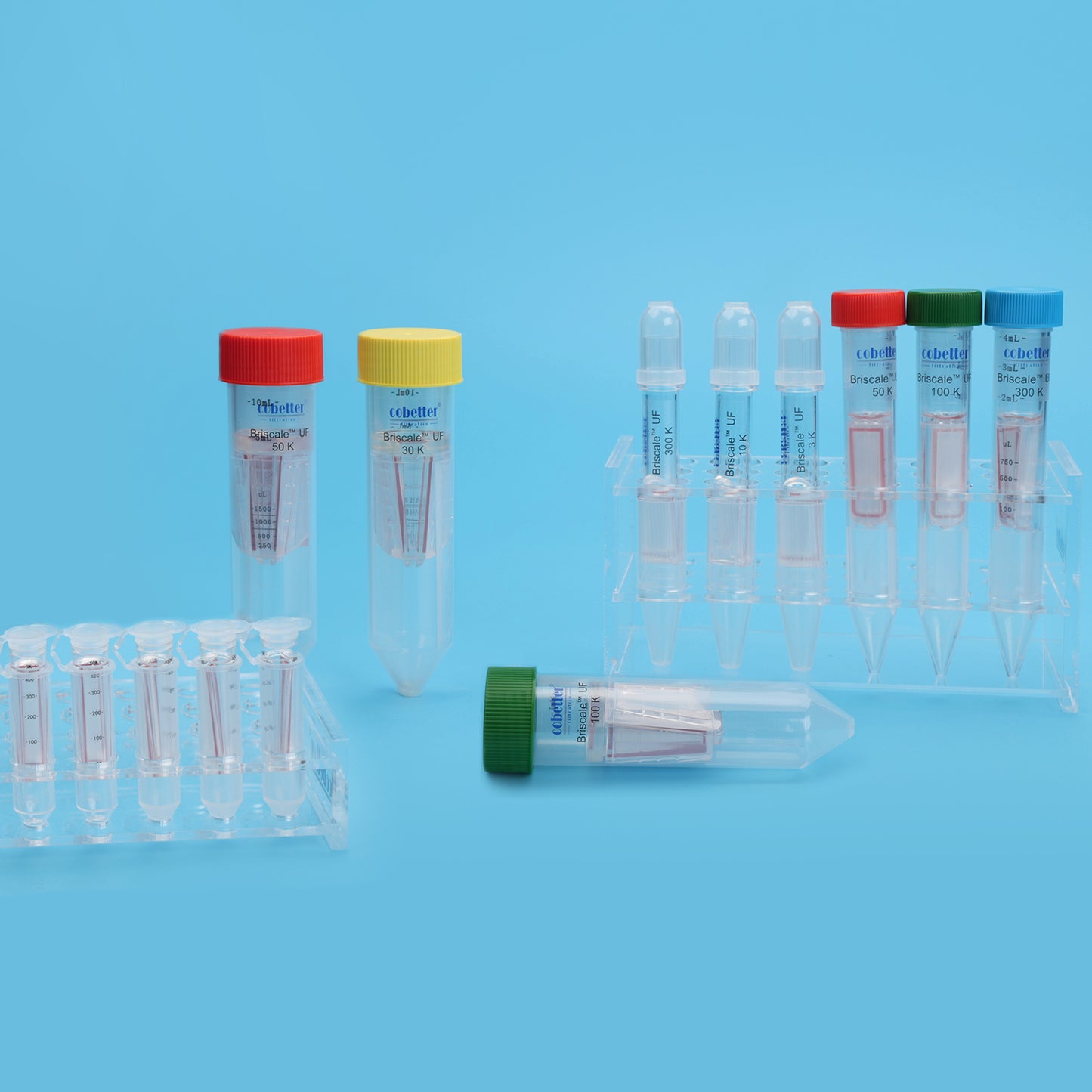
The centrifugal filter unit consists of a lid, a filter device and a centrifuge tube. Use a pipette to collect the concentrate from the filter device. The ultrafiltrate is collected in the centrifuge tube for further analysis.
BriScale 15 RC Centrifugal Filters can handle samples up to 15 mL in rotors accepting 50 mL centrifuge tubes. Use in fixed angle 45°rotor(max starting volume of 12mL) or swing bucket rotor(max starting volume of 15mL).
Specifications
| Dimensions | Effective membrane area | 7.4cm² | ||
| Overall Length x Tube diameter | 119.6 x 29 mm | |||
| Materials | Membrane Material | Regenerated Cellulose (RC) | ||
| Centrifuge Tube | PP | |||
| Ultrafiltration device | Polystyrene (GPPS) | |||
| Lid |
High Density Polyethylene (HDPE) | |||
| Concentrator Capacity |
|
|||
| Maximum Sample Volume |
|
|||
| Dead-stop volume |
|
|||
| Final concentration volume | 150-300μL | |||
| Centrifuge |
|
|||
| Maximum G-force |
|
|||
| Sterility | Delivery Condition |
Nonsterile | ||
| Sterilization Method |
Not Recommended | |||
| Package | Pack Size | 4pcs or 24pcs | ||
| Packaging | Individually packed in PE bag |
Features
- RC membrane achieves a high recovery rate of>90%
- Color-coded cap with different MWCO, volume graduation for easy detection and user-friendly
- Low-binding regenerated cellulose(RC) ultrafiltration membranes
- Broad chemical compatibility pH 1-14
- 80-fold concentration with vertical membranes
- Translucent housing and volume marker make sample monitoring effortless
Applications
- Concentration and purification of nucleic acids, proteins such as antigens, antibodies, enzymes, etc and other biomolecules
- Desalting, buffer exchange and dialyzing proteins and antibodies for sample preparation
- Concentration of dilute or pre-purified proteins from chromatography
- Remove primers, adapters or molecular tags from the reaction mixture
- Purification of macromolecules in tissue culture extracts or cell lysates, and protein removal prior to HPLC and mass spectrometry
How to choose Cobetter Centrifugal Filters?
To choose which type to use, determine the molecular weight (MW) of your macromolecule of interest, and select an ultrafiltration membrane with a molecular weight cut-off (MWCO) that is 2-3 times smaller than the MW of your macromolecule. Read more details about how to choose MWCO filters.
| Filter MWCO | Target MW |
| 3 kDa | 6 kDa < MW < 30 kDa |
| 10 kDa | 30 kDa < MW < 100 kDa |
| 30 kDa | 100 kDa < MW < 200 kDa |
| 50 kDa | 200 kDa < MW < 500 kDa |
| 100 kDa | 500 kDa < MW |
Centrifugal Filter Units Structure & Adapted Equipment
Cobetter ultrafiltration centrifugal filter units consist of a lid, a filter unit, and a centrifuge tube.
It requires a rotor or rotor adapter compatible with 15mL (for 4mL centrifugal filter) or 50mL (for 15mL centrifugal filter) conical bottom centrifuge tubes. Both the swinging bucket rotor and the fixed-angle rotor must meet this requirement. Learn more about how to use a centrifugal filter.
Protein Recovery Rate
The RC membrane and smooth inner wall design have extremely low protein adsorption. Can achieve a recovery rate of more than 90%.