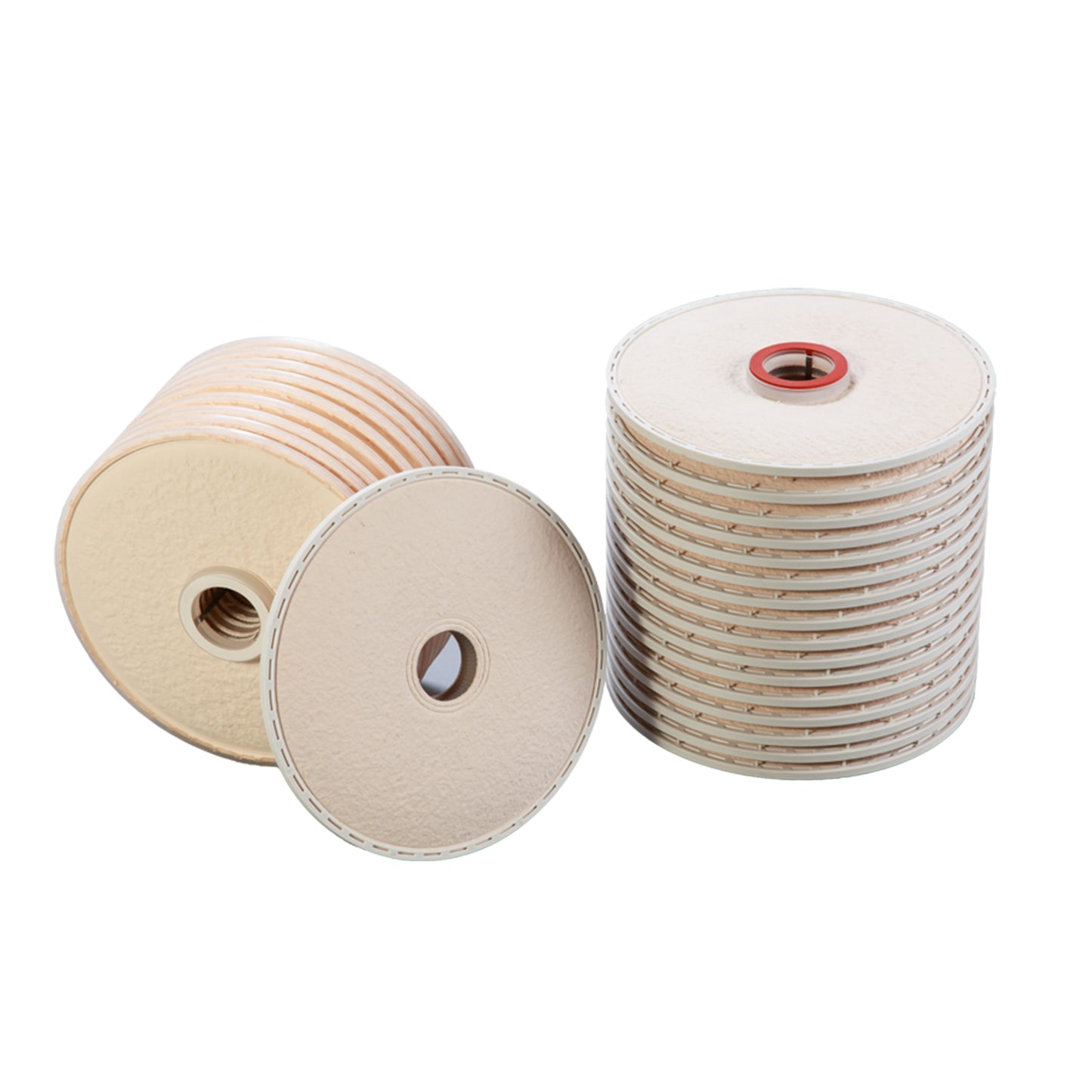
Roheap CSD Double-layer Depth Filter Lenticular Capsule

In stock
Part No. CSD-IIH2HPPCDOE12XSP
Diameter
Pore Size
Number of Stacks
Loading locations...
*Not for medical use

Cobetter Claricap CSD & Roheap CSD series filter is composed of high purity lignocellulose and inorganic filter aid agent by special technology. Its three-dimensional inner structure makes it to be a depth filter medium while providing excellent filtration efficiency and high dirt holding capacity.

Filter paper is manufactured using super-matic production lines. All raw materials are tested by a strict quality control process to ensure filter quality and good performance in any application.

Features

  • Excellent Retention Efficiency

Claricap CSD & Roheap CSD Series Filter has a three-dimensional inner structure, and the pore size decreases gradually as the depth increases, the flow rate of the solid particles will be reduced which allows them to be collected.

Diatomaceous earth----as an inorganic filter aid, its natural porous structure provides a good particle adsorption effect and increases the permeability of paperboard.

There's a small amount of synthetic resin in the filter paper which can not only improve the wet strength of the paper, but also provides a positive charge that ensure the adsorb efficiency.

  • Excellent Characteristics

Using a high purity cellulose, reduceing the level of ion precipitation and endotoxin makes the CSD Series suitable for biopharmaceutical and other high purity applications. The filter designs solve many of the problems found in typical disk-style filters such as leakage, heavy use, and high costs.

The filter aid agent in the filter paper creates an inner crisscrossing three-dimensional structure which ensures a higher dirt holding capacity and longer lifetime.

Applications

  • Fermentation broth and cell culture media clarification filtration
  • Serum and blood products filtration
  • Enzyme preparation filtration
  • Particle removal filtration
  • Colloidal and viscous materials filtration
Brand Filter Brand Roheap CSD
Material & Process Type Material of Construction Cellulose, diatomite filter aid and ionic wet-strength resin
Process Type

PE: Negative Charge

PC: Positive Charge

Physical Properties Filtration Area per layer

12 inch: 0.11 m²

16 inch: 0.23 m²

Max. Temperature 80°C
Max. Differential Pressure 0.24 MPa/80°C
Flush

Double Layer: 100L/m²

Flow Rate 10L/min/m²
Biological Safety Endotoxins <0.25 EU/ml
Bio-compatibility Meet the requirement of USP<87> In Vitro Cytotoxicity Test;

Meet the criteria of the USP<88> Biological Reactivity Test for Class VI-121°C plastics.
Package Delivery Condition Nonsterile
Pack Size 1/pk


Chemical Compatibility

Solvent Concentration @20°C @80°C
NaOH 2% G
P
HCl 5% G
P
HNO₃ 5% G P
H₂SO₄ 10% G P
Acetic acid 38% G G
Citric acid 10% G G
Acetic Peracid 0.1% G G
Butanol 80% G G
Ethanol 80% G
G

G=Compatible;  P=Incompatible


Extractable Metal Ions

PC Ions ppb Ions ppb
Mg
5.201 Ni 0.334
Al 34.540 Cu 0.770
Ca 63.447 As 0.532
Cr 0.047 Pb 0.04
Fe 27.287


Flow Rate Diagram

Flow Rate Diagram
  • Cobetter_Depth_Filtration_Claricap_CSD_Roheap_CSD_2409 Download
What materials are primarily used for Cobetter depth filtration products?

Depth filtration products are primarily composed of a mixture of three materials: cellulose, filter aids, and resins. Cellulose is mainly divided into two categories: synthetic fibers and natural cellulose. Filter aids are further classified into diatomaceous earth, perlite, activated carbon, and others. Based on these foundational materials, Cobetter have further developed a variety of new materials for our depth filtration products , such as synthetic cellulose, synthetic silica, and polymer materials, among others.

What is a reasonable method for operating depth filtration?

Depth filtration products are primarily operated using a constant flow filtration mode, and it is necessary to control the appropriate process flow rate during operation.

Why should depth filters be flushed with water before use?

1. To reduce the shedding of inherent materials and leachable.
2. To remove air bubbles, thereby facilitating the effective utilization of the filter's surface area.
3. To ensure thorough wetting, which helps enhance the mechanical strength of the filter.

What is the shelf life of depth filters, and can they still be used after expiration?

The shelf life is 3 years. It is not recommended to use after expiration because the performance and filtration efficiency of expired products cannot be guaranteed.

Can depth filtration products be reused?

No, depth filtration products are designed for single-use only.

What's the maximum pressure tolerance of Cobetter depth filters?

Depth filters can tolerate pressures of 2.4 bar at 80°C or 3 bar at 40°C. However, actual usage should be tailored to the application scenario. For example, for CHO cell harvests, the pressure is generally recommended not to exceed 1.5 bar.

What is the maximum operating temperature for depth filters? Can depth filters be sterilized?

The maximum operating temperature of depth filters is 80°C. Capsule-format depth filters are suitable for offline sterilization, while stacked-format depth filters are suitable for in-line sterilization.

What are the advantages and benefits of Cobetter depth filters?

1. A wide range of media is available for both single-layer and multi-layer products.
2. Flexible modular design allows process volumes to be scaled from 0.5 L up to 2000 L or higher.
3. All products are ready-to-use, requiring no housing assembly, CIP, or cleaning validation.
4. Robust construction and easy installation, with reduced footprint for convenient use in limited spaces.
5. High product yield is achieved due to minimal hold-up volume.