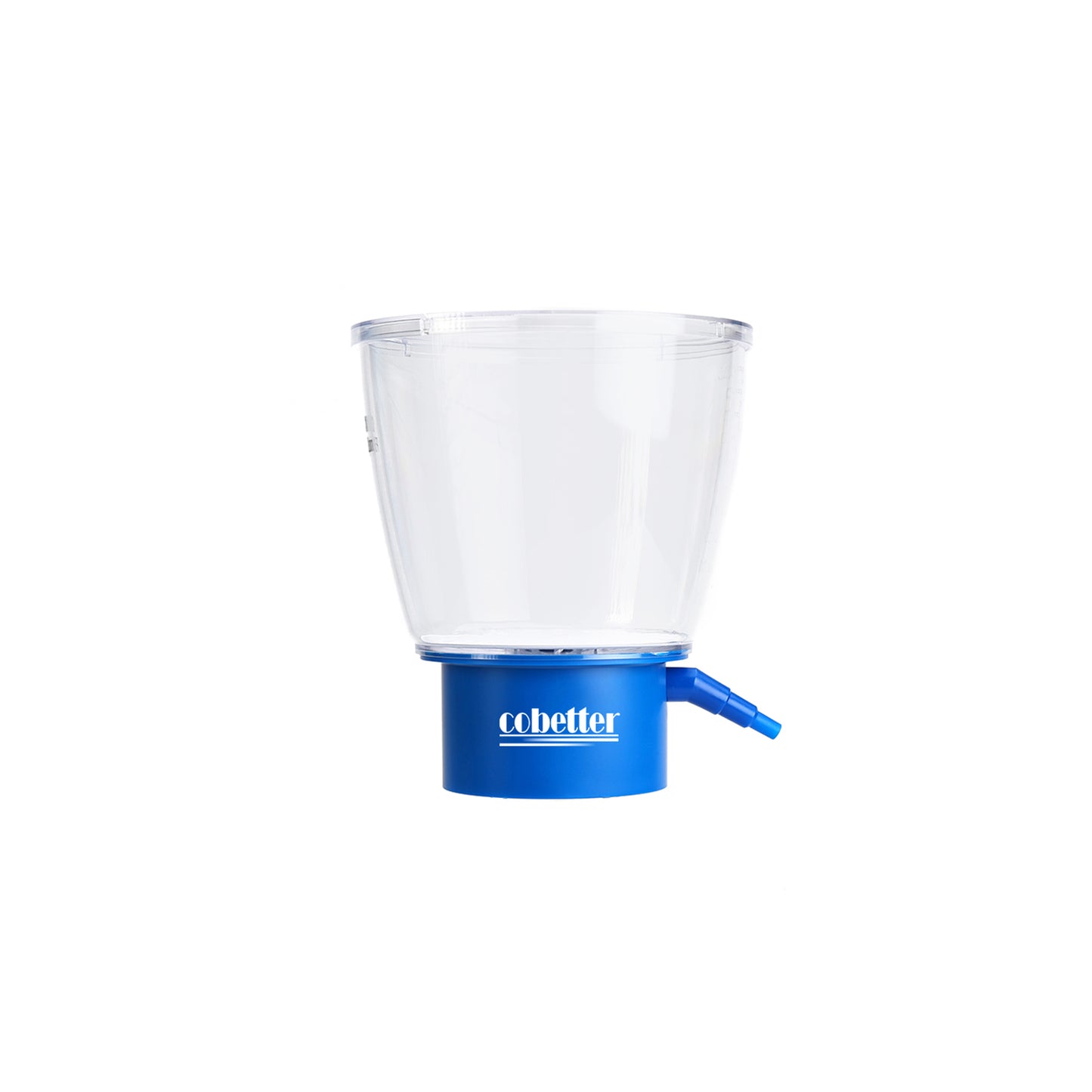
BriScale™ VTF Sterile Disposable Bottle Top Filter Funnel PES Membrane

In stock
Part No. VTF150MLEBSP
Regular price $312.00 USD
Volume
Pore Size
Package
Loading locations...
*Ships within 12 Business Days
*Customers are responsible for any import duties or taxes
*Read our Shipping Policy and Refund Policy
*Not for medical use

Features

  • Integrated welded funnel and connector design for leak-free performance
  • Large filtration area for faster processing
  • Lightweight design with a wide-mouth receiver bottle and low center of gravity for easy handling
  • High flow rate, high throughput, and low protein adsorption

Applications

  • PES membrane is ideal for sterile filtration of culture media, drug intermediates, buffers, and protein bulk solutions
  • Delivers excellent filtration performance
Physical Properties Intended Use for Research Use Only
Filter Format BriScale™ Bottle Top Filter Funnel
Filtration Area 150 mL /250 mL: EFA - 41.8 cm² (φ73 mm)

500 mL /1000 mL: EFA - 63.6 cm² (φ90 mm)
Pore Size 0.1 /0.2 /0.45 /0.65 /0.8 /1.0 μm
Wettability Hydrophilic
Materials Membrane Material Polyethersulfone (PES)
Funnel/ Lid GPPS
Vacuum Tubing Barb High-Density Polyethylene (HDPE)
Funnel-to-Bottle Connector HIPS
Biocompatibility Compliance USP <87> In Vitro Biological Reactivity Test

USP <88> Biological Reactivity Test for Class VI plastics
Sterility Delivery Condition Sterile
Sterilization Method Gamma irradiation
Package Pack Size 150 /250 mL: Pack of 48

500 /1000 mL: Pack of 32
Packaging Individually packed in double PE bag
What materials and specifications are available for Cobetter disposable vacuum filters?

Available materials: PES/PVDF/Nylon/MCE.

Specifications:
150mL:EFA 19.6 cm²
250mL:EFA 19.6 cm²
500mL:EFA 38.5 cm²
1000mL:EFA 63.6 cm²

What are the main applications of PES vacuum filter?

PES vacuum filters can be used for aqueous laboratory sample filtration, including buffers, culture media, cell harvest fluids, clarified E. coli lysates after centrifugation, and sterile filtration of proteins, among others.

Besides considering the chemical compatibility of the membrane, which other parts come into contact with the fluid and need to be evaluated for chemical compatibility?

The parts of a vacuum filter that come into contact with the fluid include:

Filter body: made of GPPS

Blue connector: made of PE (the liquid flows through this area and is in brief contact)

Common aqueous solutions are generally well compatible with these materials. If the fluid contains organic components, compatibility should be confirmed in advance. You may also consult Cobetter technical experts for verification.

Can Cobetter diposable vacuum filters be used in the aseptic operation room?

Cobetter vacuum filter cups can be used in the aseptic operation rooms. They are pre-sterile and packaged in double-layer bags. After entering the buffer area, the outer packaging can be removed, and the inner packaging can be brought into the aseptic operation room for unsealing and use.

Can the receiver bottle be stored directly in a freezer?

The receiver bottles can be stored and used briefly at low temperatures down to –70 °C, but long-term storage at this temperature is not recommended.

What filtration method is used for vacuum filters, and what are the recommended operating conditions?

Vacuum filters use negative-pressure (vacuum) filtration, typically paired with a vacuum pump.
The recommended operating pressure is –0.4 bar to –0.6 bar.
The connectors are compatible with tubing ID 1/2" (6.4 mm) to 3/8" (9.6 mm).

Can vacuum filter be reused?

Not recommended for reuse.
Cobetter vacuum filters are pre-sterilized by gamma irradiation and cannot be autoclaved, so they cannot be re-sterilized or reused.